Written Response
I worked on a site that unveils different characteristics of cultures only if you taste it. This written response specifies similarities between my project and the work of Georges Perec and Metahaven. These two influential resources helped me develop my investigation on the Seven Dials Market and the term “Street Food”.
From the beginning of the project to the first investigations on the site, I got inspired by the book “Species of Spaces and Other Pieces“, written by French novelist and writer Georges Perec in 1974. In his book, Perec (1974, p. 50) notes his observations of the street, writing down what is “most obvious, most common, most colourless.” and “Make an effort to exhaust the subject…” I get off the ground to implement these on my site. I started by observing people: Where are they coming from? Why do they come for? What are their behaviours at the market? Which paths do they follow? How much time do they spend on certain actions? As Perec offered, I tried to note every tiny detail about the consumers, which helped me to understand them intensely. Then, when I investigate and photographed the storefronts, kitchens, menus, trays, and the presentation of the foods, they all seemed uniformed. Even though there were six different cultures and cuisines behind every counter and, they all have different tastes. Through the second and third weeks of my investigation, I noted and classified the tastes of the foods I ate and decided to investigate the term “Food” at the market profoundly.
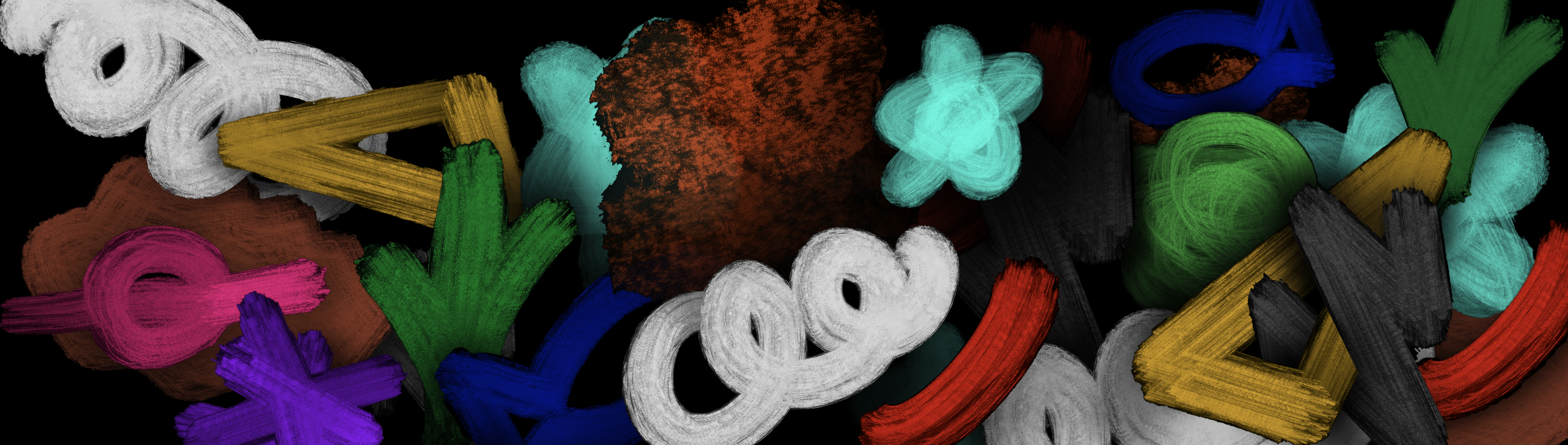
The other resource that provides insight is the book “Uncorporate Identity“, edited by Metahaven (2010). In the book’s introduction (2010, p. 6), Metahaven states, “with design’s ability to visualise that which is supposed to be there – but is not – or is there, but goes unseen: uncorporate identity.” gave me an itch to visualise the tastes that I felt when I tried all of the foods by giving them a colour and an abstract shape. Then, I composed those finalised shapes to produce a set of images to visualise the six different foods. They all contain the same shapes and colours for each, and every taste represented. As Metahaven stated (2010, p. 7), “Corporate objects do not seem to be very interesting. They are impersonal and cold.” maybe it is also valid for eating food from outside. There is much cultural food in different cuisines, but we can see them at best when they are cooked at locals’ houses. Yet, I do not think my project was affected too much because I focused on the taste notes. Their tastes should be more or less the same.
To sum up, my investigation of the Seven Dials Market showed me that most of the things about these kitchens are uniformed: their storefronts, signage, menus (same size), trays, and way of presenting the foods. However, the main difference appears inside the kitchens: their layout, appliances, production line, traditional recipes, ingredients, and most importantly, “tastes of the foods”, which is impossible to understand by looking at the trays. That is where I felt I needed to visualise the different tastes and show off these foods with abstract illustrations.
REFERENCES:
- Perec, G. (1974). Species of Spaces and Other Pieces. London: Penguin.
- Metahaven (2010). Uncorporate Identity. Zurich: Lars Muller Publishers.