
by Hazel Graham, Hakan Cilek and Jiayi Wang
About Project
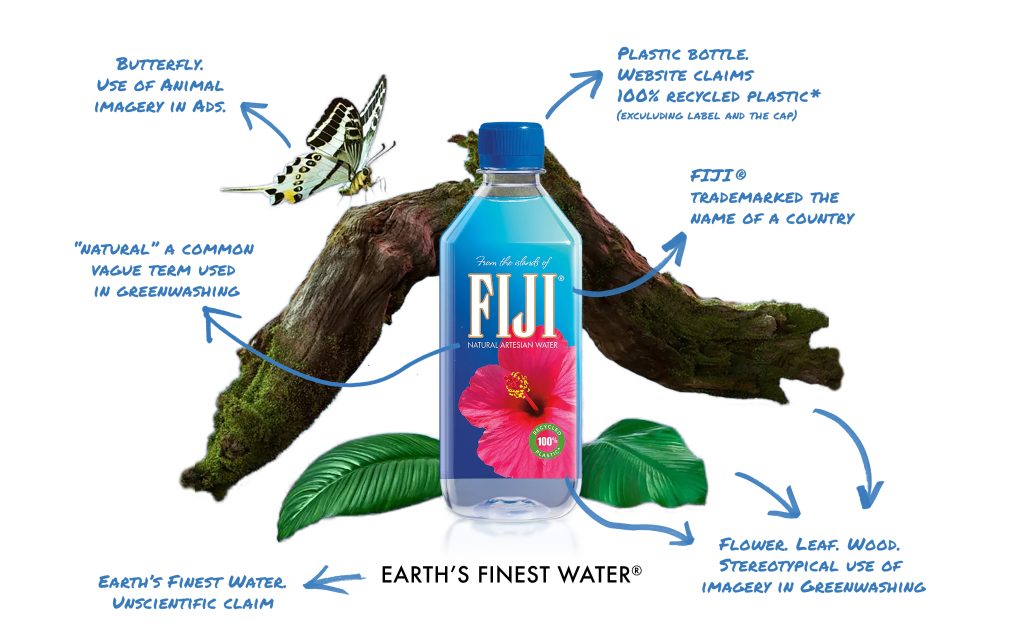
We identified FIJI Water as our ‘green’ advertising campaign. We used this campaign to interrogate the ways in which designers are implicated in questions of climate justice and positioned ourselves through the lens of ‘overconsumption’ as noted by Danah Abdula, and ‘ecofeminism’ as noted by the Ecofeminist Toolkit.
We initially interrogated ‘greenwashing’ in the campaign through methods of investigating, diagramming and iterating. We uncovered juxtaposition and contradiction in the adverts and the wider brand. This interrogation highlighted the inter-relationships between global and local communities, as whilst FIJI water extracts and packages this natural source, 47% of Fijians don’t have access to clean water. Compounding the issue was an encouraged overconsumption of bottled water that results in increased plastic waste.
The campaign has a consistent story that relies heavily on the Western ‘reading’ of the text from the context it is situated within, which is advertising. The overarching brand story being told predominantly through imagery, is one of connection to nature, the earth and luxury. Ironically, the contextualisation of the graphic communication designer, in this case, sits within the boundaries of an advertising agency that inherently pedals the patriarchal and capitalist system they sit within, consistent with the position and context of FIJI Water.
We chose to translate and iterate the emergent theme of telling stories through imagery, or ‘communicating without words’. We positioned ourselves outside of the agency and used graphic communication design to highlight the marginalised and oppressed communities who are adversely affected by climate justice and to highlight the consequences of overconsumption. By removing the words and using images in silence, we hope to foreground the complexities and intersectionality of FIJI water instead of greenwashing.


ON THE SURFACE JUXTAPOSITION {CONTRADICTIONS}


What is Beneath the Surface ?


What Is Beneath That We Can’t See?


Graph

Posters


Animals


The Book



References
- Chandni, M., Hamilton, J., Perret, M., Marizet, D., Kazemi, K. (2023) Ecofeminism. Intersectional Environmentalists
- Abdula, D. (2022) “Contradictions of Sustainability” (Futuress, 22nd November 2022).
- Plan A (2021) How to spot greenwashing. Available at: https://plana.earth/de/academy/how-to-spot-greenwashing (Accessed: 7th February 2024).
- Liboiron, M 2021, Pollution Is Colonialism, Duke University Press, Durham. Available from: ProQuest Ebook Central. [20 February 2024].
- Women’s Earth Alliance and Native Youth Sexual Health Network (2016) Violence on the Land, Violence on Our bodies: Building an Indigenous Response to Environmental Violence. Available at: http://landbodydefense.org/uploads/files/VLVBReportToolkit2016.pdf (Accessed: 12th February 2024)
- United Nations (2023) The Climate Changed Logo. Available at: https://theclimatechangedlogo.com/ (Accessed: 9th February 2024).
- Ahmed, S. (2017). ‘Introduction: Bringing Feminist Theory Home’, Living a Feminist Life. Duke University Press. P1-18.
- Hoyle, S. (2020) Psychic Refuge. Available at: https://www.psychicrefuge.com/en. (Accessed: 7th February 2024)
- Lynam, I. (2015) Why we should be really concerned about the visual identity for the Tokyo Olympics Available at https://medium.com/@ianlynam/why-we-should-really-be-concerned-about-the-visual-identity-for-the-tokyo-olympics-969830d0e819 (Accessed: 18th February 2024)
- Leborg, C. Visual Grammar, Princeton Architectural Press, 2006. ProQuest Ebook Central, http://ebookcentral.proquest.com/lib/ual/detail.action?docID=3387308.